“This feels like the Nokia era of robotics,” says Peter Fankhauser, “where, yes, you have first devices, but you're going to look back on those devices in a couple of years and you'll smile and say, ‘that's old school stuff.’ ” ANYBotics’ cofounder and CEO is a man after my own heart with that analogy. Those who’ve heard me prattle on about my own career know I kind of backed into this robotics thing a decade-plus ago through my consumer hardware writing (how I backed into consumer hardware is a story for another day).
A quarter-century after its release, one can appreciate the Nokia 3310 for what it is — a groundbreaking device that once represented the bleeding edge of mobile technology. It’s a beloved icon, so much so that it was resurrected as a kind of retro-novelty in 2017. It’s also a relic, and a kind of shorthand for the degree to which Apple signed the company’s early death warrant seven years later with the first iPhone. Industrial robots aren’t consumer electronics, of course, but the sentiment is appreciated nonetheless.
We don’t have to peer too far into the past to find quadrupedal and bipedal predecessors to the current gen systems that look downright antiquated by comparison. Are we living through the early stages of a “Cambrian explosion” Gill Pratt foresaw a decade ago? The pieces are in place for rapid advancements in robot intelligence and hardware.
Major progress has been made in recent years, though it can often be difficult to discern the forest from the trees when you’re in their midst. More often than not, this stuff isn’t properly litigated until we’re on the other side. Some prognosticators emerge looking like sages, and others move on to the next prediction, thankful that our collective consciousness has the long-term memory of a distracted goldfish. Maybe that’s why I do a podcast and a weekly newsletter.
They’re the next best things to having a working, serviceable memory. In this week’s interview, Fankhauser says ANYbotics is currently utilizing around two-thirds of its R&D spend on next-gen software/platform offerings. That said, he seemed to reject my free suggestion of “ANYbody” as a name for a potential future humanoid. Bipedal apparently isn’t on the immediate radar.
“We're not just running blindly behind copying the human form,” says Fankhauser. “For us it's the function. What it needs to do defines the form. And the beauty of robotics is that you can optimize the shape quite easily. You don't need hundreds of millions of years of evolution, and then again if you want to change your body in robotics within a few months. We can build a new prototype, and every couple of years you can build a new hardware by still being driven by the same fundamental technologies.”
Welcome to the physical AI liminal space. It’s robot limbo, waiting to give the data flywheel a sufficient nudge. Ken Goldberg has memorably described the problem as the 100,000-year data gap, referring to the sizable headstarts for sets used to train large language models versus those we’re looking to kickstart a general-purpose robot revolution.
Roboticists have introduced plenty of creative approaches to the problem, synthetic data being one of the most notable. The method utilizes simulation to train systems on seemingly infinite loops.
Each method has its strengths and drawbacks, and all will likely contribute to building the vast expanses of data necessary for approaching generalization. That data won’t always be clean and will often require post-training methods like tele-operation to further refine models.
But what of the more straightforward method? What about brute force? How far can physical AI models advance on the backs of data collected by robots interacting with the real world? More to the point: how many robots will it take to get there?
We sit at the precipice of that vast limbo. The goal is to generate enough data to kickstart the physical AI flywheel that allows systems to be deployed at sufficient scale to consistently refine and improve their own models. But deploying robots — even at a small scale — requires them to be good at at least one or two things.
The simple knowledge that robots are on the floor, slowly getting better isn’t enough for a factory or warehouse to justify deployment — those systems need to do something useful. It can (and mostly will for the time being) be something simple like loading and unloading totes, just so long as the robot is putting in the work.
When I suggest that bridging the gap this way could prove difficult, Physical Intelligence founder Sergey Levine attempts to put things into perspective.
“In the grand scheme of things, maybe sometimes something that we as researchers get a little bit mixed up about is easy for us versus easy in the context of human civilization,” the AI pioneer explains. “And in the context of the world as a whole, actually getting real world data and then deploying robots that are going to collect more experience and get better and better is a lot easier than inventing some other technologies just to avoid having to do that. And because it's a bootstrap problem, it's easier once things are out in the world.”
“When we got back from CES, we had a bunch of working [Atlas systems] and our team did a, just a big exhale, letting out all that stress and pressure,” Zachary Jackowski explains. “And then we decided, Hey, let's go do some really fun stuff, with these robots for a couple of weeks.”
The result of that collective release valve is “Atlas Airborne,” which — as of this writing — has racked up just shy of two million views on YouTube in two weeks. The video is homage of R1, the version of electric Atlas that made its global debut in 2024. Surrounded by a sea of cameras, the humanoid launches into air for a double back flip, before landing on its legs with precision and poise.
The triumphant moment is immediately followed by a full minute of the robot eating s*** in a various ways. It’s this — the glorious montage of slips and spills — that signals confidence among a team of engineers. It is, as they say in math, “showing your work.” On social media, Boston Dynamics positioned the video as “one last run in the sun” for the robot — a final victory flip and fumble before putting the battle-scarred ‘bot out to pasture.
“We were ready to let the R1 robots go,” says Jackowski, who heads up the Atlas team. “We're making static display models. We've got one up in our museum now. And yeah, we're putting them away. They're on a code branch. There's a couple people still using one. But that branch is getting increasingly divergent from the trunk.” This version of the robot wasn’t destined to work alongside humans.
Despite Atlas managing to stick the landing for the camera at least once, the robot was big and bulky. Human onlookers are conspicuously far away from the humanoid as it performs feats with varying degrees of success. To hear Jackowski describe it, the R1’s most important feat was teaching Boston Dynamics how to build a humanoid in the first place.
Another absolutely massive funding round for autonomous driving, as Wayve announces a $1.2 Billion Series D. Some of tech’s biggest names got in on the action this time, including Microsoft, NVIDIA , and Uber — the latter of whom has also been betting big on Canada’s Waabi, as the industry appears to be full speed ahead. Mercedes-Benz, Nissan, and Stellantis also participated in the round. Wayve’s post-money valuation currently sits at $8.6 billion, as the company is pushing to scale to 10 global markets with its robotaxis, on the back of Uber’s network. Wayve’s hometown of London will be the first stop.
“With $1.5 billion secured, we are building for a total addressable market that spans every vehicle that moves,” says cofounder and CEO, Alex Kendall. “Autonomy will not scale through city-by-city robotaxi deployments alone. It will scale through a trusted platform that automakers and fleets can deploy globally and improve continuously. This investment accelerates our path to widespread commercial deployment and positions us to build the autonomy layer that will power any vehicle, anywhere.”
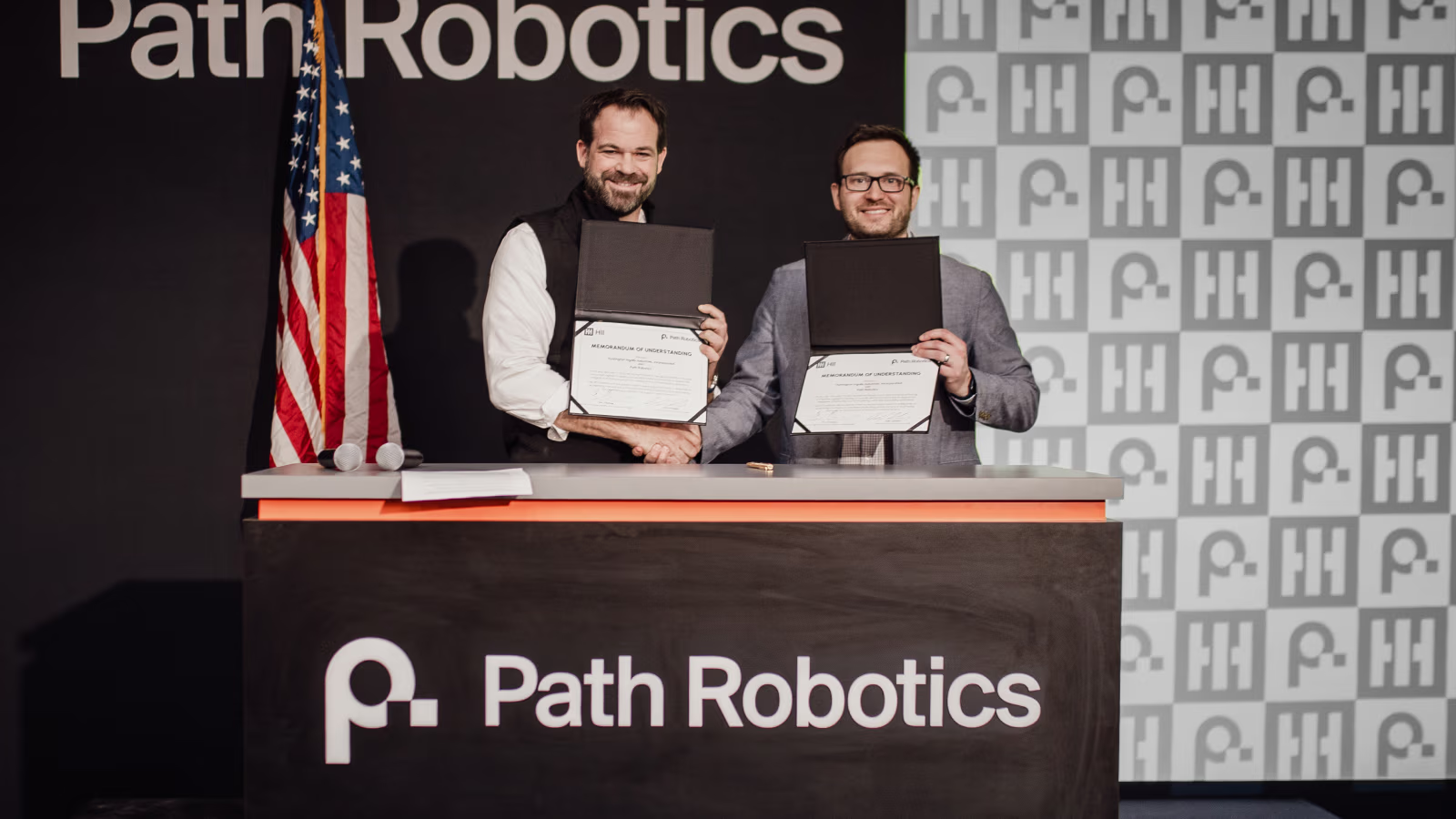
Forgive me as I’m a little late on this one — but it’s interesting nonetheless. Earlier this month, Path Robotics announced that it has signed a memorandum of understanding (MOU) with Huntington Ingalls Industries (HII), the largest military shipbuilding company in the States. It was formed as a Northrop Grumman divestiture back in 2011. Among other things, they build a lot of extremely large ships for the U.S. Navy. Columbus, Ohio-based Path, meanwhile, uses industrial robot arms to weld large structures — structures like ships.
“We are excited to partner with Path Robotics to incorporate their state-of-the-art physical AI models to further augment our workforce and speed up U.S. Navy manned and unmanned shipbuilding production,” per HII EVP, Eric Chewning. “Our shipbuilding throughput was up 14% in 2025 and we are looking for an additional 15% increase in 2026. By working with new partners like Path Robotics, we can further accelerate shipbuilding production.”
In recent months, the White House has said it is making a return to domestic shipbuilding a national economic and security priority.
Utterly transfixed by this bimanual robotic system assembling part of an Audi Q6 e-tron’s left front door. The system is using physical AI trained by Swiss startup Mimic, which allows the robot to execute complex, multiple-step processes. It’s impressive work, especially given that Mimic is new to the game, having only spun out from nearby ETH Zurich in 2024. Almost certainly the first thing that caught your eye in the below video (played back at 5x) is the fact that Mimic’s hands aren’t anchored to a humanoid body. Instead, the company is attaching one or two arms to a table or mobile robot.
Mimic writes on its site, “Our robot stations are available with one or two arms on a flexible stationary table or autonomous mobile platform. This hardware agnostic approach makes sure we always have the robot tailored to your specific use-case.” The system utilizes human demonstration videos shot from an overhead perspective to pre-train its systems, along with image and language inputs.
I've read this one through a few times, but I think I’ve got the broad strokes. Intrinsic is now a Google company — again. The robotic intelligence platform was formed deep in the moonshotty recesses of Alphabet X, before being spun off as an “Other Bet” in 2021. A lot has happened to Google’s own in-house robotics ambitions in the meantime. Fellow moonshot, Everyday Robots, was sunset, giving way to the rise of DeepMind Robotics and Gemini Robotics. Now, like the corporate approximation of a Goya painting, Intrinsic has been devoured by the entity that birthed it. The company will maintain existing collaborations with DeepMind, Gemini, and Google Cloud, while remaining “a distinct group within Google,” per the company.
“The Intrinsic team has been working for years to enable access to intelligent robotics through a democratized platform, so more people can build and benefit from robotics applications,” says Intrinsic CEO, Wendy Tan White. “Combined with Google’s incredible AI and infrastructure, we’re going to unlock the promise of physical AI for a much broader set of manufacturing businesses and developers. This will fundamentally shift production, from its economics to operations, and enable truly advanced manufacturing.”
Peter Fankhauser (ANYBotics)- ANYbotics' cofounder and CEO discusses ETH Zurich, the European startup community, deployment, and more.
Mikell Taylor (GM) - It's our first-ever live episode of Automated, now available for your pre-recorded viewing pleasure.
Brian Gerkey (Intrinsic)- We take a whirlwind trip from the early days of Willow Garage, to ROS's acceleration under Open Robotics, and his current days at Alphabet's Intrinsic.
The Association for Advancing Automation (A3) is North America’s largest automation trade association representing more than 1,400 organizations involved in robotics, artificial intelligence, machine vision & imaging, motion control & motors, and related automation technologies.