Attentive drivers may spot a sign for Foundation Building Materials as the arrive in San Francisco, northbound on 101. I clocked the sign Tuesday morning, traveling up from Silicon Valley for an in-person shoot with Robot.com for Automated, and momentarily wondered aloud about this new variety of AI models.
Turns out Foundation Building Materials is a construction material supplier. Models they specialize in are of the real world, architectural variety, stocking drywall, steel frames, and the like.
I’ve spent much of the subsequent morning trying to find some meaning in all of this. Maybe it’s to do with an overabundance of industry noise. More likely, however, it’s a signal that my brain has, once again, been rewired by this industry, and I need to carve out a bit more time to touch the metaphorical and literal grass.
I set my destination for a coffee shop near Robot.com’s HQ, leaving way too early in a bid to beat Bay Area rush hour traffic (impossible). It wasn’t until I stood directly in front of the spot that I realized what I had done. I had unknowingly typed in the address of the Creamery, a foundational location for the San Francisco tech scene that became an early pandemic casualty.
The new place is nice, for what it’s worth. Coffee Wafflee, it’s called. Edison bulbs, reclaimed wood, light jazz. As for the culinary selection, it essentially does what it says on the box.
Maybe its current owners will put a plaque out front at some point. Granted, it’s not the City Lights Bookstore or the Great American Music Store, but the coffee shop’s location across the street from the Caltrain station (a straight shot into Silicon Valley) meant a lot of the world’s biggest startups had their literal formative moments within these brick walls.
The fact that TechCrunch’s long-standing offices were right around the corner, meanwhile, solidified its legendary reputation as an assembly line for tech gossip scoops. Of course, much like the tectonic plates beneath it, San Francisco is ever-shifting — a fact certainly hastened by a global pandemic. Of course, that same global crisis had a profound impact on my corner of the industry.
Even six years ago, there was no promise a trip to the Bay would easily facilitate a week’s worth of robotics meetings (thus far we've recorded in-person episodes with Hello Robot's Aaron Edsinger, Robot.com's Felipe Chavez, Dyna's Lindon Gaoi, and of course, our live pod with Rodney Brooks). Certainly the 300+ RSVPs for our standing room only live podcast recording would have seemed like a fever dream.
It’s good to be back in one of the world’s greatest cities — one which, at times, has occupied my own top spot.
San Francisco is different every time I visit — some for the better, some for the worse. The big names on the sides of buildings and billboards along 101 are suddenly ones that are core to my own coverage.
Startups rise and fall, but the best part of being involved in robotics has always been the people — the true foundation building materials — and every time I’m back here, it’s great to see them still around.
“While I was running the commercial operations at Boston Dynamics,” Marc Theermann explains, “we always had a significant amount of inbound from people saying, ‘Can your robots come dance at my halftime show?’”
The sports world got something arguably better over the summer, when an Atlas production model activated the ball for the second half of the Brazil/Norway World Cup game. The company respected the distinction between an American association football halftime ritual enough to stop short of a full dance routine, but the humanoid still hammed it up plenty.
Theermann joined Boston Dynamics at a key turning point, brought on board by Robert Playter. The then-newly minted CEO had, in turn, recently been tapped for the top spot to usher in the commercialization era for the robotics research stalwart.
Publicity, on the other hand, was always second nature. Decades of viral video success kept Boston Dynamics’ robots in the public consciousness, culminating with a 2022 Sam Adams Super Bowl ad replete with a requisite army of dancing Spots and OG Atlases (plus a cameo from founder Marc Raibert).
In addition to halftime asks, Theermann fielded asks for robots to join performances from the likes of Katy Perry and the Rolling Stones and episodes of America’s Got Talent.
“That means there's a pull from the market to see robots in these kinds of environments,” says the company’s former chief strategy officer. “But that's not what Spot was designed for. Spot was designed to autonomously walk around in a factory and collect lots of data with superhuman sensors.”
Fair enough, but what if there were a simple way to make Spot a bit more cuddly? Something like a costume? Of a sheepdog?
Sparkles had its own moment in April 2024. A viral video was followed up by a visit with South Korea’s president. A professional puppeteer designed a blue sheepdog that looked like it could have recently shuffled out of Jim Henson’s workshop. It was one piece in a long line of internal customizations made over the years, including a happy hour Spot that was seldom without an on-board margarita blender.
Salil Raje calls it the “spine.” Conceptually, it may be something more akin to a robot’s central nervous system — a kind of web linking disparate internal components.
“Think about it as the thing that connects up all the devices, basically in that entire system,” says the SVP/GM of AMD's Adaptive and Embedded Computing Group. “Something is powering the system, the communication layer. Today, a lot of times we see an x86 CPU in the spine. It's doing the communication to the GPU, but it's also doing the communication to the joints and the limbs.”
For the past few years, a single chipmaker sucked most of the air out of the room. NVIDIA’s pivot away from mobile chips and into AI/robotics looked like a Hail Mary a decade back. But despite this week’s stock price slump, the strategy has clearly paid off.
We’ve seen an increasing number of competitors plant their own respective flags in the sand. Qualcomm, the dominant force in mobile processing, agreed to acquire software maker PickNik this week, a little less than a year after it did the same with Arduino. The Snapdragon-maker is looking to leverage its autonomous driving work into a robotics strategy focused on startups and developers.
This week also saw Texas Instruments CTO Ahmad Bahai joining the Automated podcast to discuss the firm’s work in sensing, humanoids, and mobile robots. Intel also recently reconfirmed its efforts to bring AI edge compute to robotic embodiments.
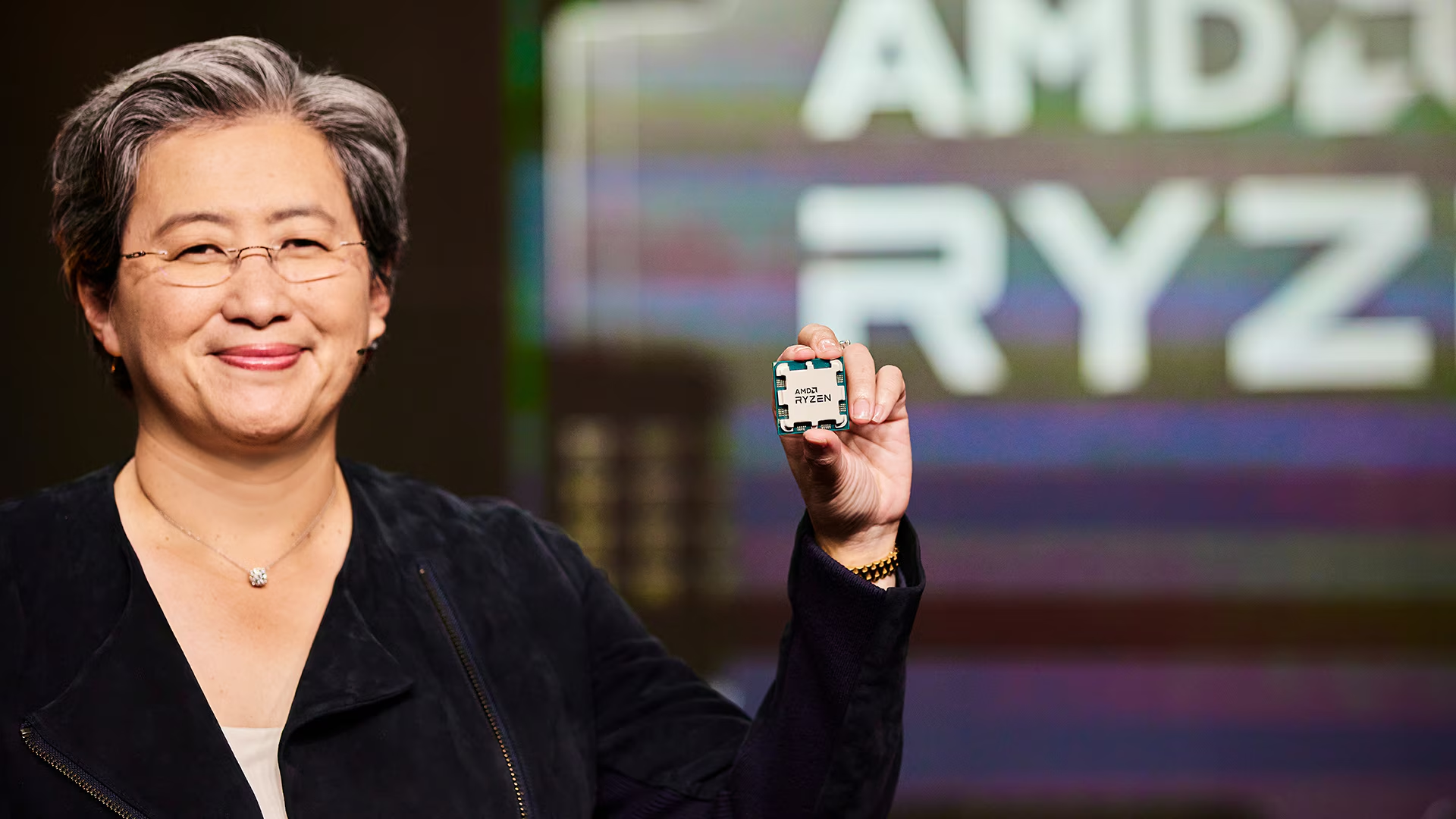
Raje notes that AMD has been operating in the space for nearly 20 years, with efforts focused on single-purpose machines. Around a year ago, however, the Santa Clara-based semiconductor firm took a deeper plunge into what we’ve collectively agreed to call physical AI — specifically in the form of generalized hardware like humanoids. Continue Reading >
Data remains one of robotics' biggest bottlenecks. Sunday's glove closely matches its Memo robot's hand, allowing people to capture high-quality manipulation data while performing ordinary tasks. This approach is cheaper and easier to distribute than collecting every training example through a robot. Watch on YouTube >
Companies cannot predict the next major market a decade in advance. What they can see are the underlying trends, including the growing demand for power density, bandwidth, timing accuracy, and local processing. Those needs now extend from massive AI data centers to mobile devices and robots that must react without waiting for the cloud. Watch on YouTube>
After a little over a year in the wilderness, RealSense has a new home. A decade after its internal launch, Intel spun the division off as a standalone 3D/computer vision company. On Tuesday, machine vision giant Cognex announced its intention to scoop up the hardware firm. Seems like a good fit. Says RealSense CEO, Nadav Orbach. "RealSense was built on a simple idea: robots and autonomous systems can't act intelligently in the physical world if they can't first perceive it accurately. We've called that mission the Visual Cortex of Physical AI. Joining Cognex puts that mission on an entirely new scale, giving us access to a global industrial customer base and go-to-market reach that would have taken us years to build on our own. This is a combination that makes both businesses stronger." A fun side note to all of this is that the deal will necessitate a spin-off of the unspun spinout. RealSense's biometrics technology, Facial Authentication, is set to become its own company prior to close.
This week is Qualcomm's Snapdragon Summit, which is (among other things) a good excuse to get your work to pay for a trip to Maui to talk about what's going to be inside next year's phones. Of course, the SoCal chip giant is more than mobile, and like the rest of the processor space, Qualcomm has found itself very bullish about robots of late. Perhaps the best exemplar occurred roughly this time last year when it bought Arduino with the intention of getting in on the ground floor of robot development. The company's gone and done it again, this time announcing plans to pick up PickNik —- perhaps best known as the steward of the MoveIt open-source framework. Qualcomm was quick to answer your first question before you ask via a press release, noting its intentions to keep things open (shades of the Intrinsic/OpenRobotics conversation from a few years back). "In addition to remaining open-source," the company writes, "MoveIt is expected to offer streamlined integration with Dragonwing robotics platforms — providing developers with a more streamlined path from AI models such as VLAs and VLMs to planning, manipulation, and real-time control."
As touched on briefly above, Intrinsic has been building out its open-source bonafides since absorbing key pieces of Open Robotics back in 2022. This week, the Google-owned firm extended its robotic reach to those just starting their journey in the space. Available for free via the company's GitHub page, Intrinsic Core complies pose estimation built atop NVIDIA FoundationPose, motion and grasp planning, simulation (via Gazebo), camera calibration, and a range of ROS drivers. “Like pre-made building blocks of robotic behavior, they can be quickly and easily combined to achieve adaptive AI solutions,” Intrinsic writes in a release tied to the announcement. “By design, these capabilities are ROS-compatible and offer more ways to improve existing applications, or build new ones with the best of ROS and Intrinsic.
Scale deployment means training at scale. Training at scale means training away from factories and warehouses that can’t afford a few months’ shutdown on the promise of future technological integration. This is a big motivator in Apptronik’s Robot Park and the “gyms” Neura has been opening in a variety of locales.
They’re also why Boston Dynamics just announced the Robotics Metaplant Application Center (RMAC), housed inside its parent company’s Hyundai Motor Group Metaplant America (HMGMA) in Savannah, Georgia. Being a subsidiary of a major automotive manufacturer has proven a kind of superpower in a number of ways, not the least of which is the access it provides to Hyundai facilities and workflows. Much like Toyota, the South Korean automaker has manufacturing down to a kind of science. Hyundai’s facilities are specifically designed around flexible cells and highly automated workflows.
“RMAC serves as a testbed and training center for integrating Atlas robots directly into Hyundai Motor Group’s automobile manufacturing operations,” per Hyundai.
“Together with Hyundai Motor Group, we are pioneering physical AI at enterprise scale,” Boston Dynamics chief product and technology officer, Zack Jackowski, says in a release. “We’re excited to be working with such a dedicated partner in the Group, and we have established a clear strategy to optimize our supply chain, production, testing, and deployment capabilities for Atlas. RMAC reinforces our shared ambition to create a future where robots amplify human potential by making work safer and more productive.”
Becca follows up her piece on the most recent Y Combinator batch by singling out a pair of startups looking to build consistent benchmarks for comparing physical AI performance. Robocurve and Hebbian Robotics are taking different approaches to an increasingly in-demand feature set as the industry is flooded with robotics and physical AI startups volleying major claims.
The big promise of generalization is a move away from the kind of brute-force programming required for autonomous systems to keep up to date with an ever-changing world. Waabi puts this well in a recent post, noting, "Geographic expansion is painstaking in this industry. Every new lane is a massive effort, worked one at a time through the same painful cycle: collect data on the route, engineer the system to handle everything that route throws at it, test it on the road, find what's still broken, and go back to collecting data again. Round and round for months or even years, before performance is good enough on that single lane." That same post notes that the Canadian autonomous trucking firm recently completed a trip from Dallas to San Antonio "with zero new real-world data, zero simulated data, and zero fine-tuning or engineering to prepare the system for the route."
A little something different from Liam this week, that's only about Pac-Man in the most superficial of ways, despite my insistence on using the above lead image. It's actually acronymish: Prediction And Control using MAchiNe. Turns out we're talking about using AI to make split-second decisions in the world of nuclear fusion. Before we dive too far into it, I want to pull out the following sentence from near the end of the piece: "The researchers note that the framework has not been designed to remove humans from nuclear fusion experiments." Single drop of sweat relieved face emoji.
Ever since its Berkeley SkyDeck acceleration, Robot.com’s food delivery offers have focused squarely on college campuses. Even as the company expands into humanoids and other industrial solutions under its recent rebrand from Kiwibot, higher ed remains the sole domain of its food service vertical, as competitors like Serve and Coco focus on denser urban environments. On Wednesday, the firm announced an expansion of its Grubhub partnership set to bring food delivery to an additional 10 campuses for the 2026-2027 school year. The deal brings the total number of schools served to more than 20.
The Association for Advancing Automation (A3) is North America’s largest automation trade association representing more than 1,400 organizations involved in robotics, artificial intelligence, machine vision & imaging, motion control & motors, and related automation technologies.



.png?upscale=true&width=1120&upscale=true&name=Dr.%20Ahmad%20Bahai%20(1).png)


.jpg?upscale=true&width=1120&upscale=true&name=ANYbotics%20Door%20Opening%20Inspection%20(1).jpg)