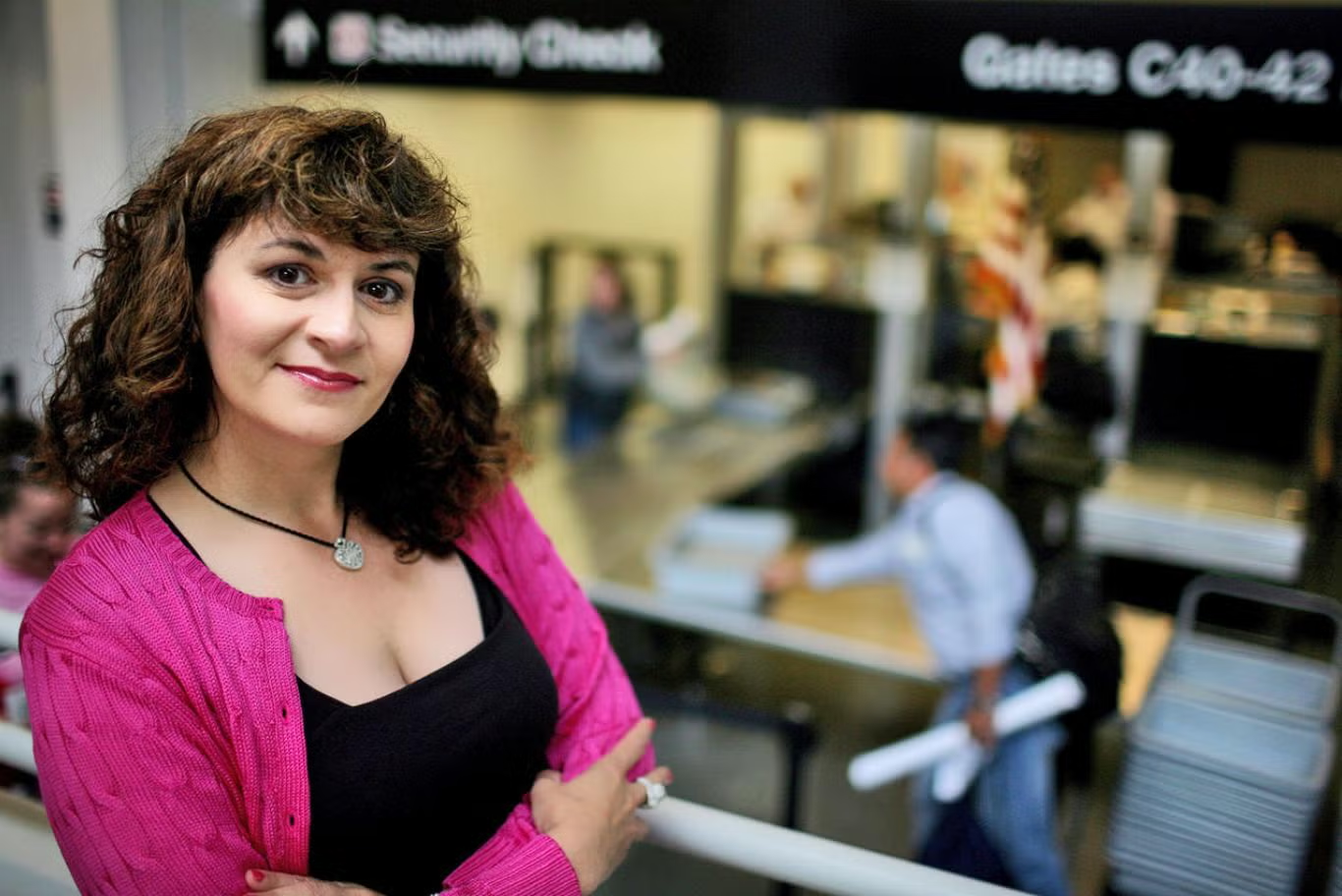
Oh boy, have we got a lot of stuff for you this week. In-house stuff, written and shot by our small, but growing team. I’ve got three original features for the newsletter, including an interview with Tufts professor/robotics ethicist Karen Panetta and Skydio head of product, Alden Jones, plus a great podcast episode with former iRobot CEO Colin Angle about his newer, furrier take on the home robot with Familiar Machines & Magic.
You’ll also find an interview we did with Tutor Intelligence cofounder and CEO, Josh Gruenstein, back when we were in Boston. That’s the first of a series of startup interviews we’re going to be running over the next few weeks. If you’re enjoying them, let us know. I’m always game to find ways to expand our startup coverage.
Speaking of, Rebecca just started her Robotics Raises roundup. Each week, she’ll be bringing you insights into robotics and physical AI movers and shakers from early stage on up. She’s also got her first full piece, wherein she interviews a Brown University researcher who taught a Boston Dynamics Spot robot how to Fetch.
Another byline debuting this week is Matthew Smith, who delivers a fun feature delving into the world of open-source robotics. Really fun stuff across the board, and all part of my plan to have other people do the heavy lifting while I deal with this head cold.
For the first 19 seconds, it could be an ad for nearly anything. An older woman walks through the front door of a suburban residence, first greeted by a golden retriever and then a smiling child. After the whole family has embraced her warmly, the camera cuts. She’s seated in a chair, mid-conversation.
Then the shift. Curious and blinking, a small white creature pokes its head into frame. A look of surprise flashes on the woman’s face, unable to make heads or tails of the presence. She beckons it to her like a household pet, taking its head in her lap.
“This is something that, if you're not motivated to touch and pet it, then boy, we did something wrong,” Colin Angle tells me, after playing the video once through. “This is something that doesn't live in a four-by-four box in front of you. This is something you can take for a walk outside.”
The rest of the spot finds the doe-eyed creature engaged in various domestic scenarios. It sits next to the child’s bed, walks around the kitchen floor wagging a nub of a tail, hangs with the family dog, engages in some light yoga, and, indeed, eventually joins the woman for a walk outside.
The strange little quadruped is a “Familiar,” the first offering from the similarly named startup, Familiar Machines & Magic (FMM). Both take their first public steps on May 4, as Angle reveals what his team has been working on since he stepped away from iRobot’s top spot in early 2024.
“There's never been a consumer robot that was able to do that,” Angle continues. “This actually lives in your space. You get up and you go to the kitchen. It can follow you and hang out with you. No robot has ever been able to do that before. Right? What we're doing is so miles beyond what has gone before.”
Angle is far from the first to lay out such grandiose claims for the infamously fickle world of home robotics. At the very least, however, his track record affords him a unique perspective. For most intents and purposes, no single company has exerted a larger influence on the category than the one he cofounded as a graduate student more than three decades ago. iRobot scored an industry-defining hit with Roomba, capturing a sweet spot between price point and utility that drove mass adoption.
“A drone is really the ability to put a sensor anywhere you need it, anytime you need it, with no friction,” Alden Jones explains. The “no friction” bit is a tall order, certainly — such are the limitations of the physical world. Skydio’s head of product acknowledges as much, while pointing at ongoing efforts to alleviate such pain points.
“Docks are remotely connected charging base stations,” the VP adds. “Before docks, drones were still somewhat limited by the staff and the people that you had to drive them around. You essentially had little Uber drivers for robots, which was kind of crazy. Now that you can put them wherever you need them and then operate them remotely. We’ve seen an explosion in our ability to deliver value for customers.”
Value has disproportionately arrived by way of DFR — drone as first responder. The “force multiplier” is more or less what it sounds like, utilizing quadcopters as the first line of defense for emergency dispatches. An army of drones sits on these docks, charging 24/7. You dial 911, and the drone dispatches to your location within seconds, piloted by a remote operator — well before fire, EMTs, or police can make their way to the scene.
Skydio puts drone launch times at under 20 seconds and arrival times at less than 90 seconds in urban environments. Remote operators are capable of managing several drones simultaneously, as applications like Pathfinder and NightSense help the systems navigate to their destination without incident. Jones says around 16 million Americans currently live within two miles of a Skydio dock, “and by the end of that this year, we think that that number is going to substantially grow.”
The Bay Area-based drone maker is firmly in growth mode. Last week it announced a $110 million Series F, a figure CEO Adam Bry called notable for “how little we are raising.” How’s that for a humble brag on a $4.4 billion valuation? Point being, the mere nine-figure funding round was a reflection of a company already in a revenue-generating position.
“I'm actually the co-inventor of the very first digital twin,” Karen Panetta notes. It’s a factoid tossed off somewhat matter-of-factly roughly halfway through a conversation about biases in physical AI. Her computer engineering work at Digital Equipment Corporation (DEC) played an important role in co-developing the simulation technology in the early 90s. It’s a pretty good flex, honestly.
Now a professor of electrical and computer engineering, along with computer science at Tufts, Panetta served as the worldwide director for IEEE Women in Engineering from 2007 to 2009, received the Presidential Award for Science and Engineering Education and Mentoring from then-President Obama in 2011, and in 2023 was inducted into the National Academy of Engineering.
Her work has focused on protecting wild elephants, studying autism, combating human trafficking, and expanding health care to underrepresented groups. While “ethical” and “responsible” are regularly tossed around like buzzwords to the point of losing nearly all meaning, Panetta has been careful to define such concepts as they pertain to her own work.
Asked to break down the distinction between “ethical AI” and “responsible AI,” Panetta invokes the Latin phrase, “primum non nocere,” that core tenet of the Hippocratic Oath that has become the foundational concept of bioethics.
“There’s always the overarching theme of ‘do no harm,’” she explains. “That means I’m not going to cause someone to lose their job or make a wrong diagnosis. That, to me, is the responsible piece.” She adds, “Ethical to me is more about how I collected the data and how I'm using it and making sure that the access is fair and equitable across and accessible.”
iRobot cofounder and former CEO, Colin Angle, returns to the home with something familiar. Watch on YouTube>
Martial Hebert (CMU) -The Dean of Carnegie Mellon’s School of Computer Science breaks down the university's advances in autonomy and offers insight into what the future holds.
Bren Pierce (Kinisi) - After finding sustained success with restaurant robotics firm, Bear, Pierce is taking on humanoids with Kinisi.
Amit Goel (NVIDIA) - Recorded live at GTC, NVIDIA's head of robotics and edge computing ecosystem discusses the company's physical AI strategy.
Meta’s front-facing robotics work has largely been confined to AI research reports. There’s no doubt, however, that the Facebook parent is making massive investments in physical AI. This week, the company picked up ARI (Assured Robot Intelligence). The news, which was first reported by Bloomberg, was confirmed by cofounder, Lerrel Pinto, who also cofounded fellow Meta expat startup Fauna Robotics. Like Fauna (and just about everyone these days), ARI is operating in the humanoid space. “Starting next week, ARI will join the Meta Superintelligence Labs (MSL) to continue advancing frontier robotics models that advance personal superintelligence in the physical world,” Pinto said in a LinkedIn post. “We have the potential to transform AI that can think and talk to AI that can do, assisting humans safely and reliably in the physical world.”
Dexterous manipulation is one of robotics’ most difficult problems. Well-funded Parisian physical AI firm Genesis AI claims to have gone a long ways toward cracking it with its latest model, GENE-26.5. And, of course, it cracked a lot of eggs along the way (it’s a French company, naturally it put the robot to work making omelets). Ten months after emerging from stealth with $105 million in funding, the company claims to have built “the first robotic brain to give robots human-level physical manipulation capabilities.” Beyond one-handed egg cracking, skills include smoothie making, wire harnessing (a notoriously difficult task for robots), piano playing, and solving a Rubik’s Cube. Sounds like a solid Thursday.
At my last job, I would go back and forth with fellow writers about whether or not there was value in covering funding rounds. By the end of my time at that gig, I arrived at the conclusion that while the news was worth writing about, the dollar amount should never be the point of the story. Fundraises are generally pivotal points for companies — often on their way up, sometimes on their way down. How the money is being spent is valuable insight into a startup’s roadmap, and — taken together — rounds provide powerful examples of macro trends for the industry. I’m excited to have Rebecca Szkutak rounding up the top robotics rounds each week.
Legitimately exciting sensor news this week, as Ouster unveils Rev8, which the company calls the “world’s first native color lidar sensor.” With a significantly higher range and resolution than its predecessor, the company is positioning the sensor as a kind of all-in-one replacement for both lidar and camera-based robotic navigation. Ouster is also boasting some big NVIDIA partnerships this time out, including support for JetPack plugins, Isaac sim, and edge processing via Orin and Thor.
Here’s Ouster CEO, Angus Pacala. “Ouster and NVIDIA’s expanded collaboration marks a pivotal moment for the robotics community. By integrating our Rev8 sensors with NVIDIA Jetson, we’re ensuring rich, high-fidelity 3D digital lidar data is fully harnessed by NVIDIA’s accelerated computing and development tools. Together, we are providing the essential building blocks for Physical AI, enabling machines to sense, think, and act in the real world with more speed and precision than ever before.”
Matthew Smith’s first feature for us covers a lot things I like talking about: open-source robots, Willow Garage, art museums, Philly. And really only one thing I try to actively avoid discussing at all costs: tariffs. That’s a pretty solid average, if you ask me. The piece peels back the curtain on the Quori project — specifically Quori v2 — by way of a conversation with Ross Mead, the founder and CEO of contributing company, Semio. It’s a good read.
Our team also sat down with researchers at Brown Unversity to discuss a novel way to teach robot dogs new tricks. Using a combination of 3D models and natural language prompts, the team was able to teach a Boston Dynamics Spot robot to fetch with 89% accuracy. “I can tell the robot to go get that object, and then with the gesture pointing towards that direction, it doesn’t have to be that precise, and the robot is still able to have a relatively robust capability to get the object,” one researcher told A3. “I think this is a step toward having robots deployed in more social environments and even toward more home environments. “
Finally, Tutor’s name is starting to make sense. Check out the newly announced DF1 Data Factory, where 100 of its Sonny robots are gathering real-world data in real time. The MIT CSAIL spinoff is using data collected from DG1 to create its Ti0 VLA (vision-language-action) model for large-scale industrial deployment. “DF1 is a 100-robot fleet of our ‘Sonny’(semi-)humanoid embodiment that enables large-scale real-world teleoperation, evaluation, and online iterative improvement of robot foundation models for dextrous bimanual manipulation,” the company writes. “Ti0 belongs to a new class of methods where the process of robot improvement is not curated by researchers, but instead driven autonomously via large-scale human supervision over deployed robot fleets. Through DF1 and Ti0, our goal is to bootstrap the world’s first commercial humanoid deployment flywheel on the Sonny platform, unlocking compounding policy improvement and real-world value over time.”
The Association for Advancing Automation (A3) is North America’s largest automation trade association representing more than 1,400 organizations involved in robotics, artificial intelligence, machine vision & imaging, motion control & motors, and related automation technologies.


.jpg?upscale=true&width=1120&upscale=true&name=Untitled%20design%20(12).jpg)


.jpeg?upscale=true&width=1120&upscale=true&name=download%20(3).jpeg)


.jpg?upscale=true&width=1120&upscale=true&name=Untitled%20design%20(11).jpg)