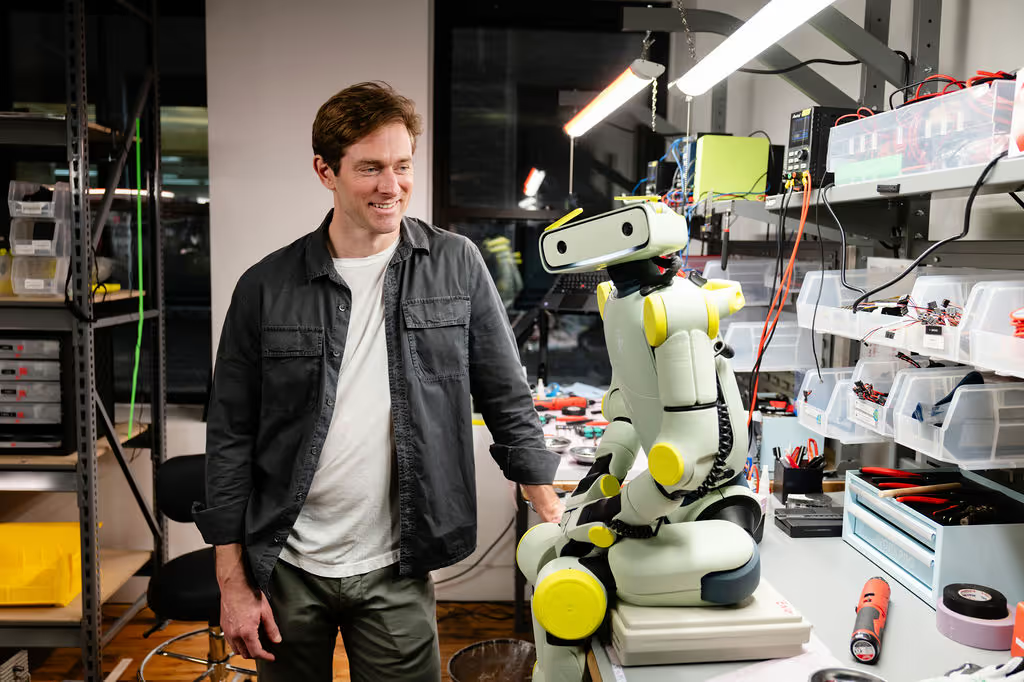
“[T]he thing that united Josh and I was shipping a product,” Rob Cochran said about fellow Fauna Robotics cofounder, Josh Merel, when I spoke with the pair earlier this year. “It felt like, given how the space is evolving, the best way to do that quickly and in a highly opinionated way was in a startup. It gave us a chance to really put on paper together an idea we had for a product and in two years get it out the door.”
The New York-based startup was founded in 2024, raised a $16.6 million seed in February 2025, and launched a developer version of its first product, Sprout, this January. For the robotics world, Fauna essentially speed ran its go-to-market, striking while the humanoid investment category remains white hot.
While Cochran and Merel’s former employer, Meta, has been a bit more transparent about its dabbling in physical AI and robotics, it’s impossible to imagine a massive operation — with all its shareholder obligations — moving at such speed.
Never mind the fact that we’re talking about an unproven space. Meta has proven itself more than willing to burn through billions annually on its VR, but it’s hard to imagine the social media giant adopting the nimbleness and flexibility required for this sort of product launch.
My full conversation with Cochran dropped in podcast form yesterday. Earlier this week, we recorded an interview with Carnegie Mellon University’s Dean of Computer Science, Martial Hebert, to mark the opening of the school’s 150,000-square-foot Robotics Innovation Center (RIC) in Pittsburgh. You can find pieces of that in our feature about the facility below, along with an interview with Coco Robotics CEO, Zach Rash.
I’m enjoying this last quiet week home in snowy New York before a bit of a marathon. I’ve got GTC coming up in San Jose, Modex in Atlanta, video shoots in Tennessee, and a big Automated trip to Boston planned for the rest of March and April.
More and that last bit soon, though I can tell you to put a hold on your calendar for March 25 at 2 p.m. ET. We’ll be doing a live chat with our friends at MassRobotics that should be a lot of fun. It’s going to be a big, fun year for Automated. I’m excited to tell you more about it soon.
At its peak, the Hot Metal Bridge facilitated the passage of some 4,300 tons of molten iron a day. During the Second World War, it saw 15% of the United States’ steel-making capacity safely cross the Monongahela River — making it among America’s most heavily guarded infrastructural objects of the era.
In 2008, the bridge underwent a $15 million renovation emblematic of Pittsburgh’s early 21st century transformation. One span was converted to accommodate automotive traffic and the other pedestrian foot traffic and bikes. LED tubes were installed, giving the passage a distinct red/yellow/orange glow after nightfall, evoking the vast quantities of liquid metal that once passed over its girders.
Just south, on the river’s east bank, the Jones & Laughlin Steel Company once employed some 12,000 workers, a figure that dwindled to the four-digits before the site was altogether abandoned in 1997. Major cleanup efforts were launched, zoning was proposed, and for a period following the turn of the millennium, the underutilized industrial space hosted testbeds CMU DARPA challenge entries and Uber autonomous driving.
In 2016, the 176-acre site was rechristened Hazelwood Green, “a historic industrial brownfield site […] transforming into a sustainable, equitable, and inclusive new model for urban development.” When completed, it will include a massive University of Pittsburgh biomanufacturing facility, offices, apartment buildings, biking trails, community meeting spaces, and a sports stadium.
On Monday, Carnegie Mellon University (CMU) marked the opening of the 150,000-square-foot Robotics Innovation Center (RIC), the first major project to call Hazelwood Green home. Among the center’s top amenities are a 6,000-square-foot drone cage, a 50,000-square-foot indoor robot test facility, and a 75,000-gallon water tank for testing submersibles.
“We had a smaller water tank here in one of the building basements on campus, but it was much, much smaller,” says Martial Hebert, the Dean of CMU’s School of Computer Science. “We are now able to conduct research and conduct projects that we could not conduct before. And this is basically the story of this entire facility, and this is the story of what we're trying to do in robotics — to continue expanding.”
The first week of March 2020 was a “complicated” time to launch a robotics startup, Zach Rash admits. The global pandemic would ultimately spell doom for countless promising startups, as a once-in-a-century event turned all conventional wisdom on its head. And then there were those that thrived amid the chaos — providing goods and services that made the strange new way of life a little more livable.
“It ended up, I think, also being a good time in a lot of ways,” Coco’s cofounder and CEO adds. “Delivery was very front of mind for restaurants and for the community. When we started, some of our first customers were the elderly and retired community of Santa Monica. We were getting them groceries. We were like working with the city to get people contact-free groceries during the first few weeks of the pandemic when everyone was super concerned about whether [Covid-19] was transmitted through packages.”
Rash and fellow recent UCLA grad, Brad Squicciarini, began building robots — and a company — in their shared Los Angeles living space.
“We were building [delivery robots] in our living room,” says Rash. “The first people we hired were in our COVID bubble, because we all kind of just like lived in the apartment together, making robots. We didn't have this like transition to remote moment, because of when we started the company. We've never been remote, ever.”
While some early pandemic artifacts — like the fear of transmission via packages and surfaces — are a distant memory, others have had a more permanent effect. Years after restaurants reopened their doors to the public, food delivery remains popular. While Coco was hardly the first robotics startup to explore sidewalk delivery, the company continues to benefit from that initial momentum.
Beyond the luck of timing, Rash says the company’s decision to work directly with restaurant partners was an important factor in its early success.
“We always set out to really focus on building a great service, not just a great piece of robot technology,” says Rash. “The first day of the business, we did real deliveries with a real business. We really built the product with restaurants — all of these little details. How does a restaurant go out to use the robot? How do they want to interact with the robot? What are all the ways to make our dispatch and order processing software as seamless as possible for them? That wasn't some second-class product decision that happened down the road. That was all incorporated on day one.”
I had a quick chat with Hexagon Robotics CEO Arnaud Robert this morning, following the news of the company’s BMW partnership. That will get the full feature treatment in next week’s newsletter. I also plan to dive a bit deeper when we’re both in California for GTC in a couple of weeks. Meantime, some interesting tidbits on the brand. First, really new. Hexagon AB (the multinational, Stockholm-based conglomerate) has been kicking for more than half a century. Hexagon Robotics (the division) only officially launched one year ago this month. Robert is an even more recent addition, coming on as CEO last June.
The bigger, older Hexagon has been working in robotics for at least a decade, per Robert. In fact, the impetus behind its humanoid was sensor work the company was doing in collaboration with Boston Dynamics’ Spot. Ultimately, it opted to just go ahead and build its own system in-house, leading to the creation of Aeon. Robert says it’s the robot’s abundance of sensors that help set it apart, allowing the system to perform parts and space inspection — a big part of the reason BMW ended up choosing the company for pilots.
A3 just revealed the first slate of speakers for June’s Humanoid Robot Forum in Chicago. The event will feature NVIDIA director of product management, Autonomous Machines Amit Goel, Apptronik co-founder and CEO Jeff Cardenas, Agility Robotics CTO Pras Velagapudi, Boston Dynamics humanoid product manager Aya Durbin, Sanctuary AI CEO James G. Wells, Kinisi founder and CEO Brennand Pierce, and NEURA Robotics founder and CEO David Reger. We’ve got some more announcements coming shortly. This year's HRF is happening at Chicago's McCormick Place convention center on June 23 and 24, in tandem with Automate and the NVIDIA-sponsored Humanoid Pavilion. I, a human, will be there in some capacity, as well.
You're forgiven for forgetting about MobED. The little mobile robot has been sufficiently overshadowed by output of Hyundai-owned Boston Dynamics. Besides, after debuting on stage a couple of CESes back, the wheeled system has amounted to little more than trade show fodder. The Korean automaker is working on changing that, however — at least, it's working with the folks who are working on that. This week, it announced the "The MobED Alliance," a "four-party cooperative model designed to create a virtuous cycle for accelerating commercialization and building a sustainable ecosystem." The group includes five robotics solutions companies, 10 components suppliers, and multiple public agencies, designed to figure out precisely what to do with the self-leveling autonomous system. Suggestions include last-mile delivery, security patrol/drone launch pad, and outdoor digital signage.
If all of that is a bit too wishy-washy for you, here's a Hyundai firefighting robot for good measure.
If you didn’t do time in the gadget blogging trenches, you might not be familiar with the name “Frog Design,” but you’ve certainly encountered the firm’s work. A fruitful Apple partnership kicked off with 1984’s IIc and included several Macintosh models stretching into the beginning of the 90s. Subsequent years have found Frog designing products for GE and Disney. Nome, on the other hand, is more theoretical. Per the company, “Nome reflects frog’s belief that adoption is a design problem. Trust, comfort, and legibility matter as much as autonomy and intelligence. By combining imagination with deep technical understanding, this work serves both as a lens for imagining new product categories and as a framework that helps organizations move from curiosity about robotics to confidence in bringing them into the world.”
Still, it’s fun to see some of the out-of-the-box design thinking, amid a sea of bipedal humanoids. Nome looks more like a piece of furniture than what we generally picture when we close our eyes and think of a home robot. Of course, given the source, this is likely more in the camp of function following form than many practical robots, but how often do you get to see a design portfolio juxtapose non-anthropomorphic robot design alongside an image of Michelangelo’s David? Might as well reach for the stars — or, at very least, the chapel ceiling.
The Association for Advancing Automation (A3) is North America’s largest automation trade association representing more than 1,400 organizations involved in robotics, artificial intelligence, machine vision & imaging, motion control & motors, and related automation technologies.



.png?upscale=true&width=1120&upscale=true&name=download%20(3).png)

.jpeg?upscale=true&width=1120&upscale=true&name=jeff%20cardenas%20hrf%202025%20(1).jpeg)